← Back to Insights
← Back to Insights
Featured Article 01
Featured Article 01
Should You Buy an Apartment Facing Another Building?
Should You Buy an Apartment Facing Another Building?
How to evaluate privacy, exposure, light, and curtain lifestyle before buying an apartment facing another building.
How to evaluate privacy, exposure, light, and curtain lifestyle before buying an apartment facing another building.
Short Answer:
Short Answer:
Yes, if the distance, privacy, light, and affected room still support daily living. The risk is not simply the view. The risk is whether the exposure changes how you use the home, keep shades open, or feel inside the space.
Yes, if the distance, privacy, light, and affected room still support daily living. The risk is not simply the view. The risk is whether the exposure changes how you use the home, keep shades open, or feel inside the space.
Many New York apartments face another building in some way. That alone does not make them bad apartments.
The question is whether the exposure changes how the home will live day after day.
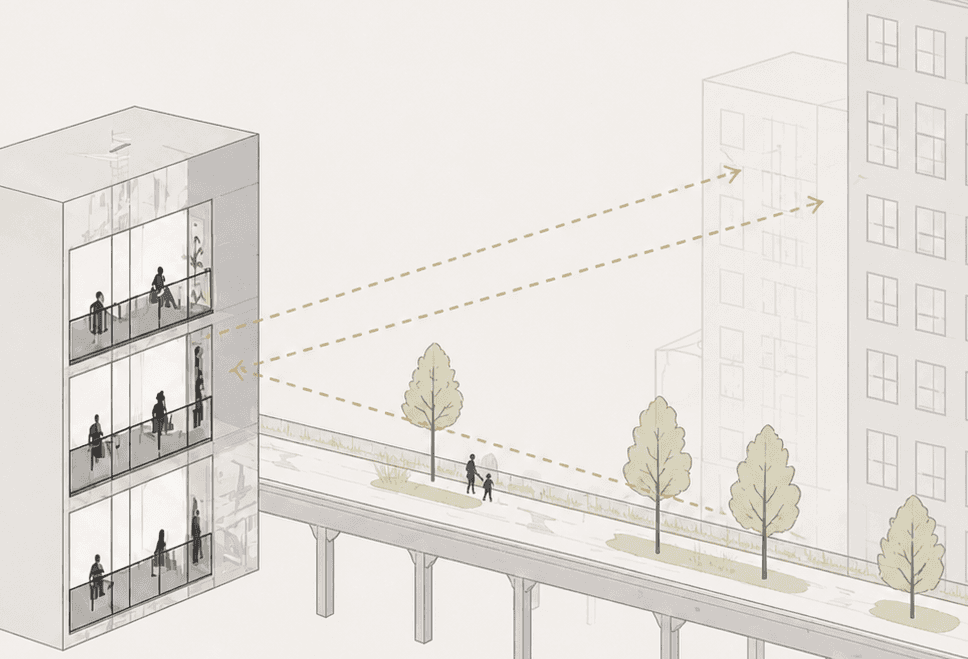
An apartment can look calm in listing photos and still feel exposed once you stand near the window. This is not only a view question. It is a privacy and livability question: who can see you, how much light reaches the room, and whether the exposure quietly changes how you use the home.
"Facing another building" can mean a wide avenue view, a narrow courtyard, a bedroom facing a brick wall, or windows aligned directly with another apartment. A weak view can be acceptable. A home that makes you feel watched, dim, or boxed in every day is a different kind of decision.
Before buying an apartment facing another building, check:
1. Distance to the opposite building
Can you stand near the window without feeling watched? Is there visible sky, or only glass and wall?
2. What the opposite building is
Residential windows, offices, hotels, terraces, rooftops, service areas, and blank walls create different privacy patterns.
3. Which room is affected
A kitchen window may be manageable. A primary bedroom or main living room with direct window alignment is more serious.
4. Light quality, not just window count
Does the room receive useful daylight, reflected light, or mostly shadow?
5. Night visibility
Would you keep the shades closed most evenings? If yes, the window is not functioning as a normal living asset.
6. Price and tradeoff
Is the compromise already reflected in the price, or are you paying as if the exposure were stronger than it is?
When Facing Another Building May Be Acceptable
Facing another building may be acceptable when the exposure is present but does not control the home.
It may work if the distance is generous, the affected room is secondary, the opposite building is low-use, the light remains strong enough, and the price reflects the compromise.
A weaker view can be acceptable if the home still feels private, usable, and balanced.
When To Be Cautious
Be more careful when the exposure starts to govern how you would live.
That may be the case if the main living room feels exposed, the bedroom requires closed shades most of the time, the only window faces another building or wall, the apartment already has weak natural light, or listing photos avoid showing the real outlook.
The clearest warning sign is behavioral. If you would keep the shades closed or use the apartment differently because of the exposure, the issue is part of the home's livability.
A Buyer-Side Verdict Framework
Avenue & Form View: A weak view is not always a problem. A home that changes your behavior — closed shades, unused rooms, or constant exposure — is a livability problem.
Use a simple Go / Consider / No-Go framework.
Go
The exposure is visible but manageable. Light remains good enough. Privacy can be handled without reshaping daily life. The tradeoff is clearly offset by other strengths.
Consider
The exposure is meaningful, but not automatically disqualifying. The answer depends on the room affected, the buyer's habits, the price, and the strength of the rest of the apartment.
No-Go
The exposure weakens the primary living experience. Shades would stay closed most of the time. Light and privacy are both compromised.
This is buyer-side livability judgment, not inspection, appraisal, legal, or financial advice.
Avenue & Form
Considering a specific apartment?
See how Avenue & Form reviews a real buyer scenario before you submit your own listing.
View Sample Review →
Learn about The Review →
Submit a Private Buyer Inquiry →
Many New York apartments face another building in some way. That alone does not make them bad apartments.
The question is whether the exposure changes how the home will live day after day.
An apartment can look calm in listing photos and still feel exposed once you stand near the window. This is not only a view question. It is a privacy and livability question: who can see you, how much light reaches the room, and whether the exposure quietly changes how you use the home.
"Facing another building" can mean a wide avenue view, a narrow courtyard, a bedroom facing a brick wall, or windows aligned directly with another apartment. A weak view can be acceptable. A home that makes you feel watched, dim, or boxed in every day is a different kind of decision.
Before buying an apartment facing another building, check:
1. Distance to the opposite building
Can you stand near the window without feeling watched? Is there visible sky, or only glass and wall?
2. What the opposite building is
Residential windows, offices, hotels, terraces, rooftops, service areas, and blank walls create different privacy patterns.
3. Which room is affected
A kitchen window may be manageable. A primary bedroom or main living room with direct window alignment is more serious.
4. Light quality, not just window count
Does the room receive useful daylight, reflected light, or mostly shadow?
5. Night visibility
Would you keep the shades closed most evenings? If yes, the window is not functioning as a normal living asset.
6. Price and tradeoff
Is the compromise already reflected in the price, or are you paying as if the exposure were stronger than it is?
When Facing Another Building May Be Acceptable
Facing another building may be acceptable when the exposure is present but does not control the home.
It may work if the distance is generous, the affected room is secondary, the opposite building is low-use, the light remains strong enough, and the price reflects the compromise.
A weaker view can be acceptable if the home still feels private, usable, and balanced.
When To Be Cautious
Be more careful when the exposure starts to govern how you would live.
That may be the case if the main living room feels exposed, the bedroom requires closed shades most of the time, the only window faces another building or wall, the apartment already has weak natural light, or listing photos avoid showing the real outlook.
The clearest warning sign is behavioral. If you would keep the shades closed or use the apartment differently because of the exposure, the issue is part of the home's livability.
A Buyer-Side Verdict Framework
Avenue & Form View: A weak view is not always a problem. A home that changes your behavior — closed shades, unused rooms, or constant exposure — is a livability problem.
Use a simple Go / Consider / No-Go framework.
Go
The exposure is visible but manageable. Light remains good enough. Privacy can be handled without reshaping daily life. The tradeoff is clearly offset by other strengths.
Consider
The exposure is meaningful, but not automatically disqualifying. The answer depends on the room affected, the buyer's habits, the price, and the strength of the rest of the apartment.
No-Go
The exposure weakens the primary living experience. Shades would stay closed most of the time. Light and privacy are both compromised.
This is buyer-side livability judgment, not inspection, appraisal, legal, or financial advice.
Avenue & Form
Considering a specific apartment?
See how Avenue & Form reviews a real buyer scenario before you submit your own listing.
View Sample Review →
Learn about The Review →
Submit a Private Buyer Inquiry →
Confidence before commitment.
Single-property reviews from $395.
Multi-property reviews from $950.
Request a Second Opinion
Your inquiry is kept private and never shared with brokers or third parties.
Confidence before commitment.
Single-property reviews from $395.
Multi-property reviews from $950.
Request a Second Opinion
Your inquiry is kept private and never shared with brokers or third parties.
Confidence before commitment.
Single-property reviews from $395.
Multi-property reviews from $950.
Request a Second Opinion
Your inquiry is kept private and never shared with brokers or third parties.
Avenue & Form
Independent pre-purchase livability reviews for NYC home buyers, focused on layout, light, privacy, noise, building context, daily comfort, and buyer fit before you commit.
We provide an independent buyer-side review to support higher-quality home decisions. We do not replace a licensed broker, attorney, inspector, appraiser, financial advisor, or tax advisor.
CONTACT: hello@avenueandform.com
© AVENUE & FORM
ALL RIGHTS RESERVED.
Avenue & Form
Independent pre-purchase livability reviews for NYC home buyers, focused on layout, light, privacy, noise, building context, daily comfort, and buyer fit before you commit.
We provide an independent buyer-side review to support higher-quality home decisions. We do not replace a licensed broker, attorney, inspector, appraiser, financial advisor, or tax advisor.
CONTACT: hello@avenueandform.com
© AVENUE & FORM
ALL RIGHTS RESERVED.